
Thomas Merton Love Quotes on Divine Connection and Loving Others

Introduction
To explore the writings of Thomas Merton is to step into a landscape where the distinction between the human heart and the divine presence begins to dissolve. This collection of Thomas Merton love quotes examines his profound conviction that love is not merely an emotion or a social contract, but the very architecture of our being. Rather than a simple list of sentiments, these reflections offer a roadmap for moving from the biological impulse to love toward a sacrificial, sacred recognition of the “other.”
The Law of Our Nature
Merton suggests that love is not an external demand placed upon us, but the fundamental orientation of the soul. He posits that finding ourselves is not a matter of looking inward in isolation, but of losing ourselves in the singular, flowing stream of divine generosity.
“The Law of Love is the deepest law of our nature, not something extraneous and alien to our nature. Our nature itself inclines us to love, and to love freely. The deepest and most fundamental exigency of the divine law in our hearts is that we should reach our fulfillment by loving.” — Thomas Merton
“There are not many kinds of love. There is only one great stream of love pouring out in endless generosity and manifesting in a multitude of ways in different relationships.” — Thomas Merton
“If the deepest ground of my being is love, then in that very love itself and nowhere else will I find myself, and the world and my brother and Christ. It is not a question of either-or but of all-in-one.” — Thomas Merton
Loving the Other as a Person
True intimacy, according to Merton, requires a radical respect for the autonomy of the beloved. These quotes challenge us to examine whether we love people for who they truly are, or merely for how they serve our own needs or mirror our own images.
“The beginning of this love is the will to let those we love be perfectly themselves, the resolution not to twist them to fit our own image. If in loving them we do not love what they are, but only their potential likeness to ourselves, then we do not love them: we only love the reflection of ourselves we find in them.” — Thomas Merton
“To love another as a person we must begin by granting him his own autonomy and identity as a person. We have to love him for what he is in himself, and not for what he is to us. We have to love him for his own good, not for the good we get out of him. And this is impossible unless we are capable of a love which ‘transforms’ us, so to speak, into the other person, making us able to see things as he sees them, love what he loves, experience the deeper realities of his own life as if they were our own.” — Thomas Merton
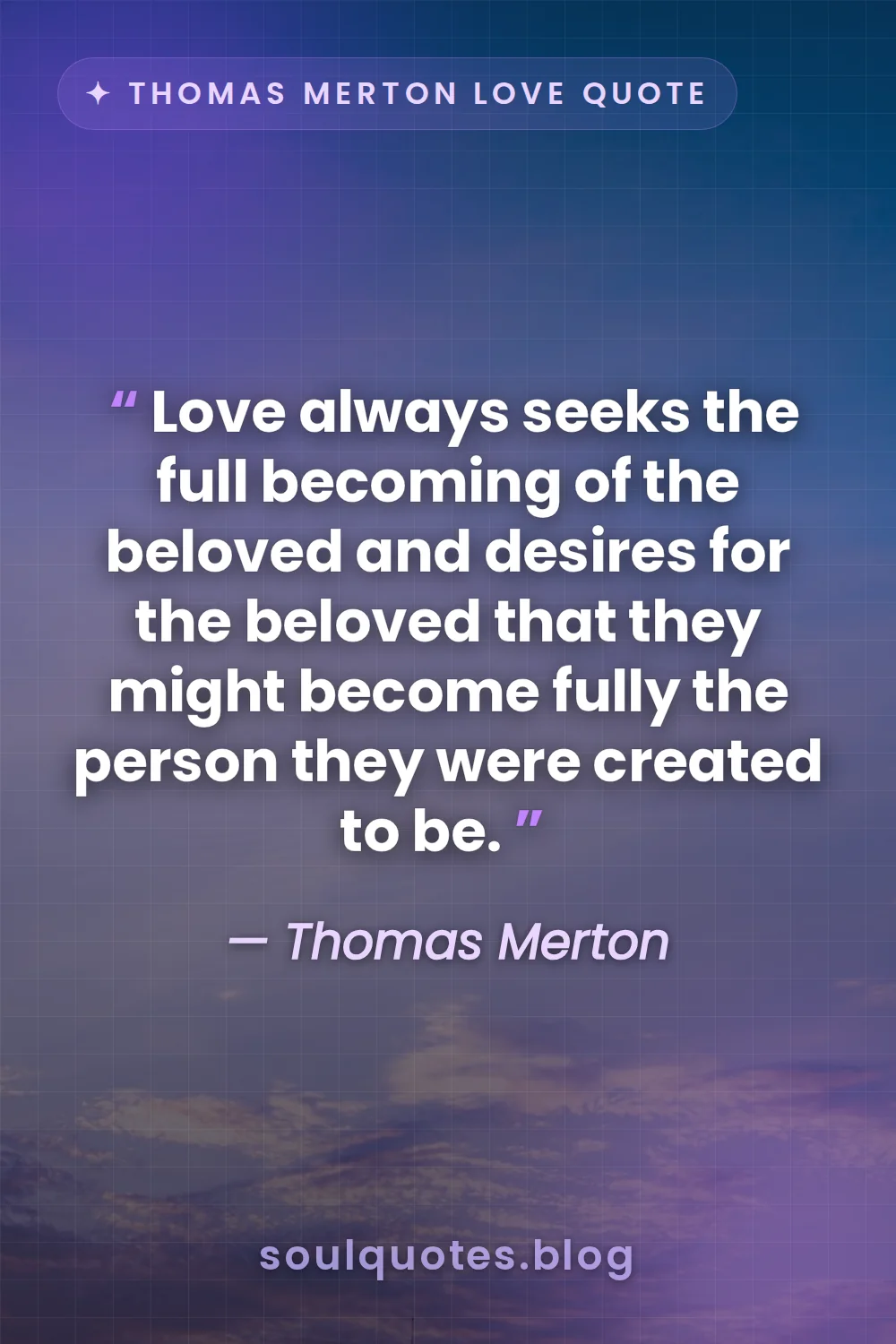
“Love always seeks the full becoming of the beloved and desires for the beloved that they might become fully the person they were created to be.” — Thomas Merton
The Sacred Presence in Humanity
Merton’s vision of love extends to the very edges of human fellowship, demanding that we recognize a divine spark in every individual. He teaches that to truly see a human being is to witness a light that transcends their flaws, their status, or their relationship to us.
“I must learn that my fellow man, just as he is, whether he is my friend or my enemy, my brother or a stranger from the other side of the world, whether he be wise or foolish, no matter what may be his limitations, ‘is Christ.’ No qualification is needed about whether or not he may be in the state of grace… any man whatever, is to be regarded as Christ.” — Thomas Merton
“To love is to see in our fellow human beings the presence of that light, truth, beauty, and indescribable dignity that, in Christian tradition we call ‘Christ’ and which we believe dwells, even if unacknowledged, in every human being.” — Thomas Merton
Navigating Disunion and Uncertainty
A realistic theology of love must account for the friction of human existence. Merton does not shy away from the reality that loving others inherently brings suffering, nor does he promise a clear map for the spiritual journey; instead, he offers the grace of trust amidst the shadows.
“As long as we are on earth, the love that unites us will bring us suffering by our very contact with one another, because this love is the resetting of a Body of broken bones. Even saints cannot live with saints on this earth without some anguish, without some pain at the differences that come between them. There are two things which men can do about the pain of disunion with other men. They can love or they can hate.” — Thomas Merton
“My Lord God, I have no idea where I am going. I do not see the road ahead of me. I cannot know for certain where it will end. Nor do I really know myself, and the fact that I think that I am following your will does not mean that I am actually doing so. But I believe that the desire to please you does in fact please you. And I hope I have that desire in all that I am doing. I hope that I will never do anything apart from that desire. And I know that if I do this you will lead me by the right road though I may know nothing about it. Therefore will I trust you always though I may seem to be lost and in the shadow of death. I will not fear, for you are ever with me, and you will never leave me to face my perils alone.” — Thomas Merton
Reflections on the Life of Merton
In studying these themes, readers often wonder about the personal application of Merton’s profound theology—specifically, did Thomas Merton fall in love? While his writings focus heavily on the divine and the universal nature of love, his life was marked by a deep, lived tension between his monastic devotion and the complexities of human connection. His words serve as a reminder that love is not a destination we reach, but a way of traveling through a broken and beautiful world.
To use these quotes is to invite a slower, more intentional way of relating to the world. Whether you are seeking comfort in moments of disunion or looking to deepen your capacity for empathy, Merton’s words remind us that the highest form of love is the simple, difficult work of allowing others the freedom to be exactly who they are.
Frequently Asked Questions
Did Thomas Merton fall in love?
The article does not explicitly state whether Thomas Merton fell in love, though it notes his life was marked by a tension between monastic devotion and the complexities of human connection.
Related Articles