
Carl Jung Spiritualism Quotes on Shadow Work and Self-Discovery

Introduction
To engage with the work of Carl Jung is to step away from the superficiality of the ego and descend into the profound architecture of the human psyche. This collection of Carl Jung spiritualism quotes serves as a map for those navigating the difficult but necessary terrain of shadow work and self-discovery. Rather than a mere list of aphorisms, these curated reflections are organized to guide you through the stages of individuation: from the initial confrontation with the unconscious to the ultimate integration of the soul with the infinite.
The Path of Self-Discovery and Individuation
True growth is rarely a linear ascent toward light; it is a complex process of becoming whole. These quotes explore the necessity of tension, the importance of looking inward, and the realization that our identity is often a mask that hides a much deeper reality.
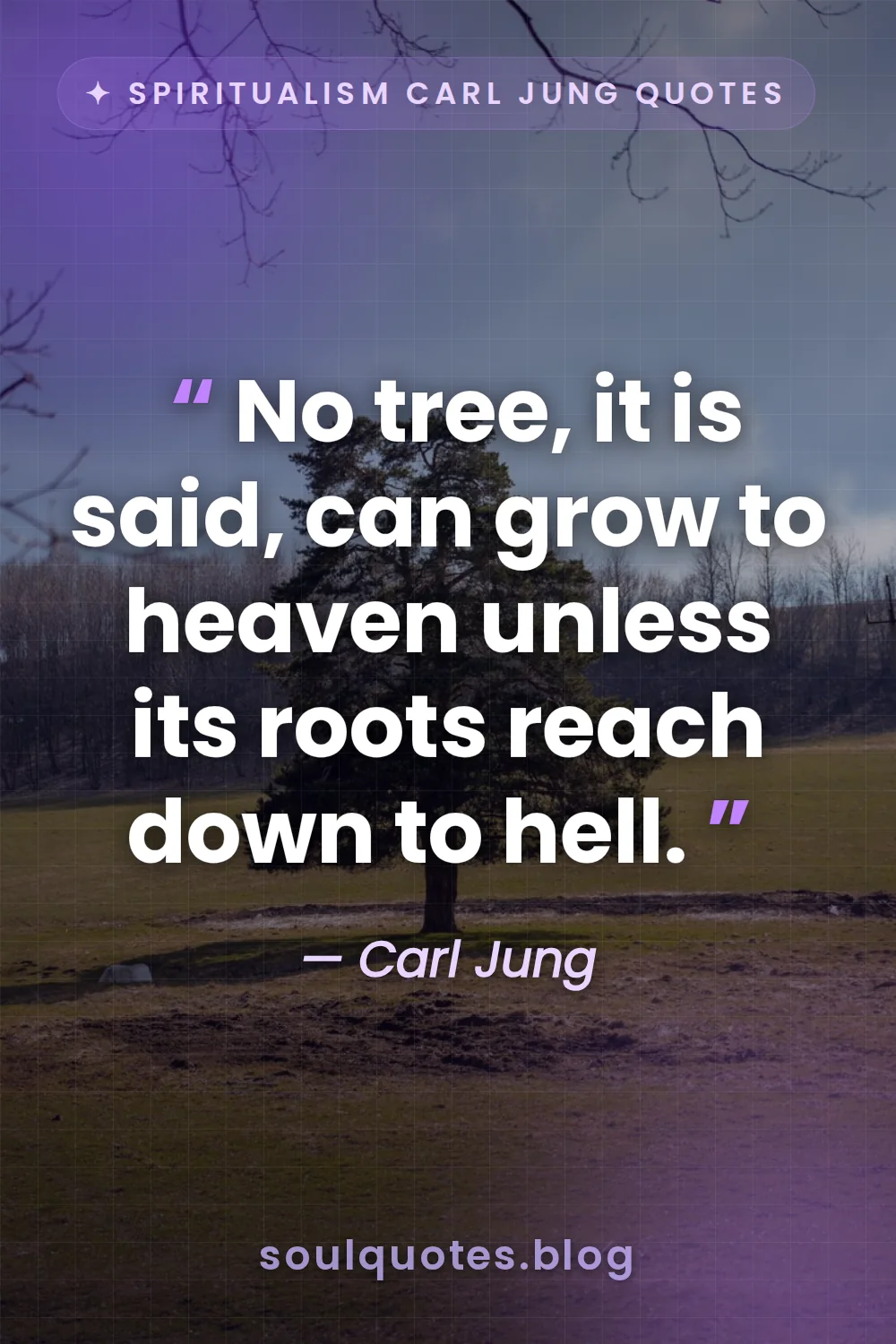
“No tree, it is said, can grow to heaven unless its roots reach down to hell.” — Carl Jung
“Until you make the unconscious conscious, it will direct your life, and you will call it fate.” — Carl Jung
“The most terrifying thing is to accept oneself completely.” — Carl Jung
“Identity does not make consciousness possible; it is only separation, detachment, and agonising confrontation through opposition that procure consciousness and insight.” — Carl Jung
“We meet ourselves time and again in a thousand disguises on the path of life.” — Carl Jung
“Your visions will become clear only when you can look into your own heart.” — Carl Jung
“Who looks outside, dreams; who looks inside, awakes.” — Carl Jung
“I am not what happened to me, I am what I choose to become.” — Carl Jung
The Shadow and the Moral Self
The most transformative work occurs in the dark. These reflections focus on the “shadow”—those repressed, unacknowledged parts of our character—and the moral courage required to face our own capacity for darkness to achieve genuine enlightenment.
“The acceptance of oneself is the essence of the whole moral problem and the epitome of a whole outlook on life. That I feed the hungry, that I forgive an insult, that I love my enemy in the name of Christ — all these are undoubtedly great virtues. What I do unto the least of my brethren, that I do unto Christ. But what if I should discover that the least among them all, the poorest of all the beggars, the most impudent of all the offenders, the very enemy himself — that these are within me, and that I myself stand in need of the alms of my own kindness — that I myself am the enemy who must be loved — what then? As a rule, the Christian’s attitude is then reversed; there is no longer any question of love or long-suffering; we say to the brother within us ‘Raca,’ and condemn and rage against ourselves. We hide it from the world; we refuse to admit ever having met this least among the lowly in ourselves.” — Carl Jung
“One does not become enlightened by imagining figures of light, but by making the darkness conscious.” — Carl Jung
Connection to the Infinite and the Numinous
Beyond the individual psyche lies the vast, numinous connection to something greater than the self. These quotes address the fundamental human question of our relationship to the divine and the limitations of organized structures in facilitating direct spiritual experience.
“The decisive question for man is: is he related to something infinite or not?” — Carl Jung
“One of the main functions of organized religion is to protect people against a direct experience of God.” — Carl Jung

Understanding the Journey
As you reflect on these words, you may find yourself searching for deeper meaning regarding specific aspects of the human experience. Below are insights into common inquiries related to Jungian thought:
- On Self-Love and Purpose: Jungian philosophy suggests that purpose is found not by seeking external validation, but through the “individuation” process—the journey of integrating all parts of the self to become a unique, whole individual.
- On the Soul and the Unconscious: The soul is often understood in this context as the bridge between our daily ego and the vast, unconscious depths that drive our instincts, dreams, and spiritual longings.
- On Life’s Challenges: What many perceive as “fate” or unexplainable hardship is often the unconscious attempting to demand attention, forcing us to confront the shadows we have neglected.
Synthesis
The wisdom contained in these quotes suggests that the spiritual life is not an escape from reality, but a deeper immersion into it. By embracing the tension between light and dark, and between the ego and the infinite, we move closer to a life of true consciousness and meaning.
Related Articles